Before the War, If There Is One
A personal reflection on narrative power, emergent systems, psychological uncertainty, Krishna, and choosing conviction before the outcome is known.
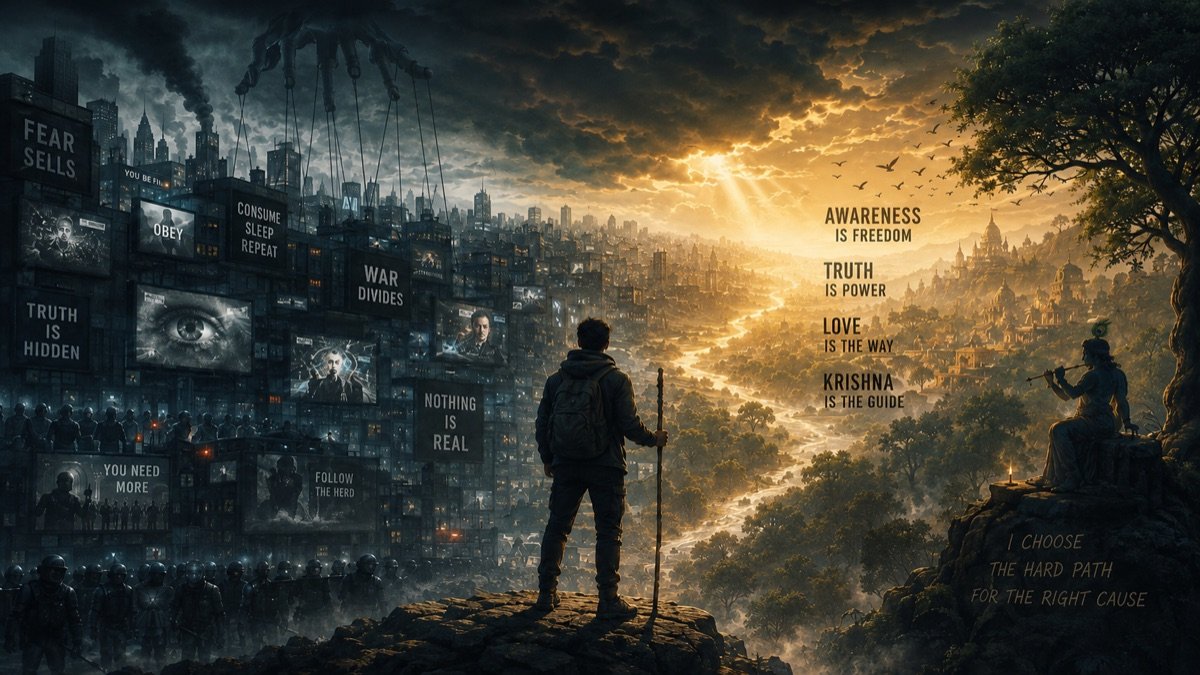
I am writing this before I know whether any of what I am thinking will matter. That distinction is important, because there is a possibility that I am catastrophically overestimating the significance of what I am working on. There is a possibility that I have entered a grandiose loop, that I have convinced myself I am approaching something historically important, that powerful forces will eventually resist it, and that some larger responsibility has somehow fallen upon me. Given my own psychological history, I cannot dismiss that possibility. In fact, intellectual honesty demands that I write it down before I write anything else.
Maybe I am wrong. Maybe I build something, release it, and almost nobody cares. Maybe somebody finds this article years later and laughs at the disproportion between the scale of my language and the scale of what I actually accomplished. Maybe I become a screenshot, a joke, another man on the internet who thought he was about to change civilisation. That is a real possibility.
But I have made a calculation. If I am wrong, the cost is mostly embarrassment, and the internet has an extraordinarily short memory. It consumes humiliation on an industrial scale. One person becomes the centre of attention today; another replaces him tomorrow. Within a week, the collective nervous system has usually found a new object to stimulate itself with. Eventually, I disappear into the same digital graveyard as millions of other forgotten people. I can live with that.
The other possibility is the reason I am writing this. What if I am not entirely wrong? What if the mechanism I am working on actually functions? What if it begins touching something much larger than the product itself: attention, behaviour, collective psychology, perhaps even the way people interpret their own minds? And what happens if such a mechanism begins interfering with structures whose survival depends upon controlling precisely those things?
Then this article becomes useful. Not because it proves a conspiracy, and not because I can predict who will oppose me, but because it establishes something before there is anything to defend: what I believe I am trying to do, what I fear I may be wrong about, and what questions I was asking before anybody else had the opportunity to answer them on my behalf.
That is why publishing this is a risk I am willing to take.
Narrative Is More Powerful Than Most People Realise
We like to imagine that human beings form opinions by observing reality and independently reaching conclusions. Most of the time, that is impossible. The world is too large. You cannot personally visit every war, audit every corporation, read every government document, verify every scientific paper, witness every political event, or understand every economic movement.
So between reality and the individual mind sits an enormous interpretive infrastructure: news, cinema, political language, advertising, social media, search engines, history books, algorithms, influencers, institutions, culture. Narrative.
An event occurs, but almost nobody experiences the event directly. They experience a representation of the event. A headline compresses it. A photograph frames it. A commentator assigns causality. An algorithm decides whether you see it. Your existing beliefs decide whether you accept it. Your social group decides whether acceptance carries a social reward or a social punishment. Eventually, something extraordinarily complicated becomes a sentence: “This is what happened.” That sentence enters millions of minds.
This is why I increasingly regard narrative not merely as communication, but as infrastructure. If physical infrastructure determines how bodies move through a civilisation, narrative infrastructure determines how minds move through it. Whoever possesses disproportionate influence over that infrastructure possesses a form of power considerably more subtle than physical coercion. You do not necessarily need to force somebody to behave in a particular way. Alter the informational environment around them sufficiently, and there is a chance they will arrive at the desired behaviour believing the conclusion was entirely their own.
That possibility should concern everyone. Not because every narrative is centrally engineered, but because narrative engineering undeniably exists. Governments use it. Corporations use it. Political campaigns use it. Military organisations study it. Advertisers perfected large parts of it. Social media companies industrialised its distribution. Today, algorithms can perform amplification at a scale no newspaper editor in history could have imagined.
The battlefield has moved. Territory still matters, weapons still matter, economics still matters. But increasingly, perception itself is strategic territory.
The Obvious Theory: Somebody Is Controlling It
Once you begin looking at these mechanisms, one interpretation becomes seductive: someone must be controlling this. A deep state, an elite network, governments, corporations, financial interests, military interests, or some combination of people wealthy or powerful enough to manufacture narratives, sponsor conflicts, influence culture, manipulate attention, and preserve their position. There is enough documented manipulation in human history to make the hypothesis emotionally plausible.
Power tries to preserve itself. That should surprise nobody. At an almost animal level, control reduces uncertainty, uncertainty produces vulnerability, and vulnerability creates fear. So institutions attempt to maintain control, and people do the same thing on a smaller scale. This does not require supernatural evil. Sometimes the psychology may be remarkably ordinary: if I lose control, I lose stability. If I lose stability, chaos enters. If chaos enters, everything I have becomes vulnerable. From inside that psychology, an action that appears oppressive from the outside may even feel defensive to the person performing it.
I try to remember this. I would prefer not to reduce the world to villains. Perhaps many people operating inside powerful institutions genuinely believe that what they are doing maintains stability. Perhaps they do not wake up every morning thinking, how can I make humanity worse today? Human beings rarely experience themselves as villains. They construct moral architectures around their own behaviour. That does not make harmful consequences disappear; it simply makes the system more difficult to understand.
And if one day I become inconvenient to some powerful incentive, I may find myself on the receiving end of that machinery. That possibility exists. But there is another possibility that I have historically given far less attention to, and strangely, I now find it more frightening.
What If Nobody Is Controlling Anything?
What if there is no central room? No final operator. No coherent deep state coordinating the entire movement. What if the world increasingly behaves like an autonomous system produced by billions of smaller incentives interacting with one another?
The politician wants votes. The corporation wants revenue. The shareholder wants returns. The social platform wants engagement. The advertiser wants attention. The government wants stability. The military establishment wants strategic advantage. The media organisation wants relevance. The individual wants security, status, and belonging. Every participant optimises locally, and the aggregate behaviour begins producing something no participant consciously designed.
Power follows attention. Attention follows emotional intensity, and emotional intensity is frequently amplified by fear, outrage, desire, and tribal identity. Attention becomes revenue. Revenue strengthens the structures capable of capturing more attention, and those structures improve their ability to manipulate it. The cycle feeds itself. Nobody needs to sit at the centre controlling it. The system can become emergent.
That possibility fundamentally changes the problem. A controlled machine has an operator; remove the operator and perhaps the machine changes direction. But an emergent machine does not require anyone to understand the whole thing. Everyone can be following incentives rationally while the collective result becomes irrational. Everyone can be doing what makes sense from their local position while civilisation itself drifts somewhere nobody consciously chose.
That is a much stranger kind of danger, because then there is nobody to defeat. There is only the pattern.
Zero or One
At some level, the question is still binary. Either the process has an ultimate controller or it does not. Zero or one. But once you enter either side, the branches multiply.
Suppose there is human control. Then how much? Who exercises it? Is it coordinated or fragmented? Are different power centres competing with one another? Are they even capable of understanding the consequences of what they control? And above all, where does God fit into that architecture? One possible answer is free will: human beings possess agency, and God permits human beings to act even destructively inside a reality governed by consequences. The existence of God would therefore not automatically imply that every human action represents divine endorsement. That is one branch.
Now move to the other side. Suppose there is no meaningful human controller, no deep state coordinating civilisation, no secret architecture capable of directing everything. Narrative warfare exists, certainly, but it is fragmented. Manipulation exists, but no one controls the totality. Conflicts emerge, technologies emerge, markets emerge, cultures evolve, and billions of actions continuously collide. Then another binary appears: God exists, or God does not.
If God does not exist, the proposition becomes deeply unsettling to me. It means that consciousness appeared somewhere inside matter, began experimenting with technology and social organisation, and is now accelerating into forms of complexity that no individual human mind fully understands. There may be no destination, no intelligence outside the system, no guarantee that intelligence produces wisdom faster than it produces capability. We may simply be exploring possibility space, building because we can build, optimising because optimisation is rewarded, expanding because expansion produces power, and discovering consequences only after entering them. That possibility is terrifying.
But suppose God exists. Then the same apparent chaos may exist inside a deeper order that I do not understand. Not necessarily deterministic control, not necessarily a cosmic puppet show, but causality. Action and reaction. Karma, if one wants to use the older language. Human actions produce consequences; those consequences alter environments; environments condition future actions. Individual psychology produces collective structures, and collective structures return and modify individual psychology. A loop. Perhaps God's architecture does not require the elimination of human freedom. Perhaps the architecture operates through consequence.
I do not know. And increasingly, I am comfortable writing those three words: I don't know. The temptation to manufacture certainty simply because uncertainty is psychologically uncomfortable may itself be one of the most dangerous cognitive tendencies we possess.
The Variable I Cannot Remove: Myself
There is another system I have to analyse with the same suspicion: my own mind. If I am willing to question governments, corporations, algorithms, narratives, and collective psychology, then I cannot conveniently exempt my own perception from scrutiny. My mind also constructs narratives. My mind also detects patterns. My mind also converts ambiguity into meaning. My mind also has incentives. And my mind has a history that gives me particular reason to be careful when I begin thinking on an unusually large scale.
So I am saying this publicly: I may be in a grandiose loop. Perhaps the thing I am building is not nearly as significant as I currently believe. Perhaps I am attaching civilisational importance to something that will eventually prove ordinary. Perhaps the responsibility I feel exists largely inside me. Perhaps no powerful opposition is coming, and nobody cares enough to oppose anything.
That possibility does not humiliate me anymore. It protects me. Because the moment I become incapable of considering the possibility that I am wrong, I become exactly the kind of closed system I claim to be questioning. Epistemic humility is not weakness. It is error correction, and I need error correction.
But uncertainty cuts both ways. I cannot say, because grandiosity is possible, every large idea I have must be false. That would be another irrational conclusion. Psychological history does not automatically invalidate an argument. An idea has to survive contact with reality. That is the test. Build it. Expose it. Measure what happens. Let the world answer.
Why Write This Before Anything Happens?
Because narrative is retrospective. Once something happens, everybody rewrites the past from the perspective of the outcome. A successful person was always destined for success. A failure was always obviously delusional. A controversial movement was always dangerous; a celebrated movement was always visionary. Reality is rarely that clean while it is happening.
So I want this article to exist before I know the answer, not as prophecy, but as evidence of uncertainty. If everything fails, let this remain as a record that I understood failure was possible. If I become ridiculous, let it record that ridicule was inside my calculation. If nothing happens, fine. But if what I am working on ever becomes significant enough that narratives form around me or around the work, then I want at least one document untouched by hindsight. Something that says: before the outcome, I knew I might be wrong. Before any opposition, I refused to invent enemies. Before anybody labelled my intentions, I wrote them myself.
And what I am trying to do is remarkably simple to describe, even if execution is not. I am trying to influence collective consciousness. That phrase sounds grandiose, and perhaps it is. But the mechanism itself is not mystical. Collective consciousness is simply what begins emerging when enough individual minds share patterns of interpretation. Advertising changes those patterns. So do education, religion, political propaganda, cinema, social media, and algorithms. Culture is continually programming and reprogramming the cognitive environment.
So the question is not whether collective consciousness can be influenced. It already is, every day. The question is: towards what? Fear? Consumption? Outrage? Sexual stimulation? Status anxiety? Political hatred? Endless comparison? Or towards awareness, self observation, restraint, meaning, compassion, agency, perhaps even something approaching transcendence?
That is where my interest lies. And that is also where Krishna enters this article.
The Leap
I am thirty years old. There is a particular script attached to that age, especially when you come from the middle class. Become stable. Secure an income. Reduce risk. Settle down. Construct financial certainty. Start behaving like an adult whose experimentation period has ended. There is enormous rationality in that advice. I do not mock it. In many ways, I want it.
But I am doing something that presently makes less economic sense. I am putting significant attention into something whose outcome I cannot guarantee. I am deprioritising easier sources of income. I am taking a leap at exactly the age when conventional wisdom tells me to stop leaping. And I know how irrational that can look. Maybe it is irrational. Maybe five years from now I will wish I had behaved differently.
But there is one variable that conventional economic analysis cannot fully price for me: Krishna.
There was a period when I had almost nothing meaningful left to bargain with. Another person may call what happened afterwards faith, recovery, neuroplasticity, probability, or spiritual experience. I know the interpretation through which I experienced it. Krishna brought me back. And now I possess something I did not possess then: capability. I can build. I can code. I can create. I can think again. I can learn. I can work obsessively on a problem.
And there is something inside me that finds the following proposition morally unbearable: that I should use the capabilities I was given exclusively to reconstruct a comfortable life for myself, while ignoring the thing I believe those capabilities could potentially serve. Perhaps that is foolish. Perhaps it is devotion. Perhaps it is obsession. Perhaps all three are sitting uncomfortably close to one another. I do not know.
But I know which uncertainty I am willing to live with. I can live with trying and discovering that I was wrong. I do not know if I can live peacefully with never trying, and spending the rest of my life wondering whether fear disguised itself as rationality.
And If There Is No Krishna?
I have thought about that too. Suppose there is no entity, no Krishna, no consciousness beyond matter, no divine intelligence. Suppose everything I experienced was generated entirely by my own brain.
Then I would still be forced to acknowledge something strange. An idea represented by the name Krishna entered a mind that had lost its willingness to participate in life, and somehow became involved in rebuilding it. It reorganised behaviour, changed priorities, created restraint, returned meaning, and generated enough momentum that the same mind could begin constructing things again. If that entire phenomenon was internally generated, it remains psychologically extraordinary.
But I will go further. If there is no Krishna, if there is nothing beyond matter, no deeper intelligence, no transcendence, no meaning beyond what competing biological organisms temporarily manufacture for themselves, then I find this world profoundly difficult to admire. A civilisation endlessly optimising pleasure, dominance, reproduction, consumption, and control, with every life inside it eventually terminating in biological death, does not strike me as a particularly satisfying final explanation of existence. Perhaps others find freedom in that. I do not.
So yes, I am taking the risk. The financial risk. The reputational risk. The risk of looking foolish. Even the risk of documenting, publicly, the possibility that my own mind may be misleading me. Because after considering both sides, the asymmetry still seems obvious to me. If I am wrong, I lose some time, some money, perhaps some reputation, and the internet laughs and moves on. But if I am right, even partially, and there exists some possibility of shifting a small part of our collective psychological machinery away from unconscious manipulation and towards awareness, then walking away simply because I feared embarrassment would be a much larger failure.
I cannot prove where this goes. I cannot yet tell you exactly what I am building. I cannot promise that I understand the forces I am describing. And I certainly cannot claim that I understand God.
What I can do is leave this here. Dated. Before the outcome. Before the narrative. Before I know whether this was conviction or grandiosity. Before I know whether there will ever be opposition powerful enough to justify these words. A record that I considered both possibilities. A record that I knew I could be wrong. And a record that I chose to move anyway.
At thirty, when perhaps I was supposed to finally choose safety, I chose one more uncertainty. Not because I am certain that I can win. Not because I believe I am some chosen person who must save the world. But because the one thing I remain certain of is far simpler: when I had almost nothing left, I called for Krishna. And somehow, I am still here. Now I have something to give back.
So whatever this becomes, whether victory, failure, embarrassment, irrelevance, opposition, or nothing at all, I know why I entered it.
I have chosen my war.
Hare Krishna.