Love
Can love exist without conditions? A reflection on attraction, desirability, the dopamine economy, and what remains of love when everything else is removed.
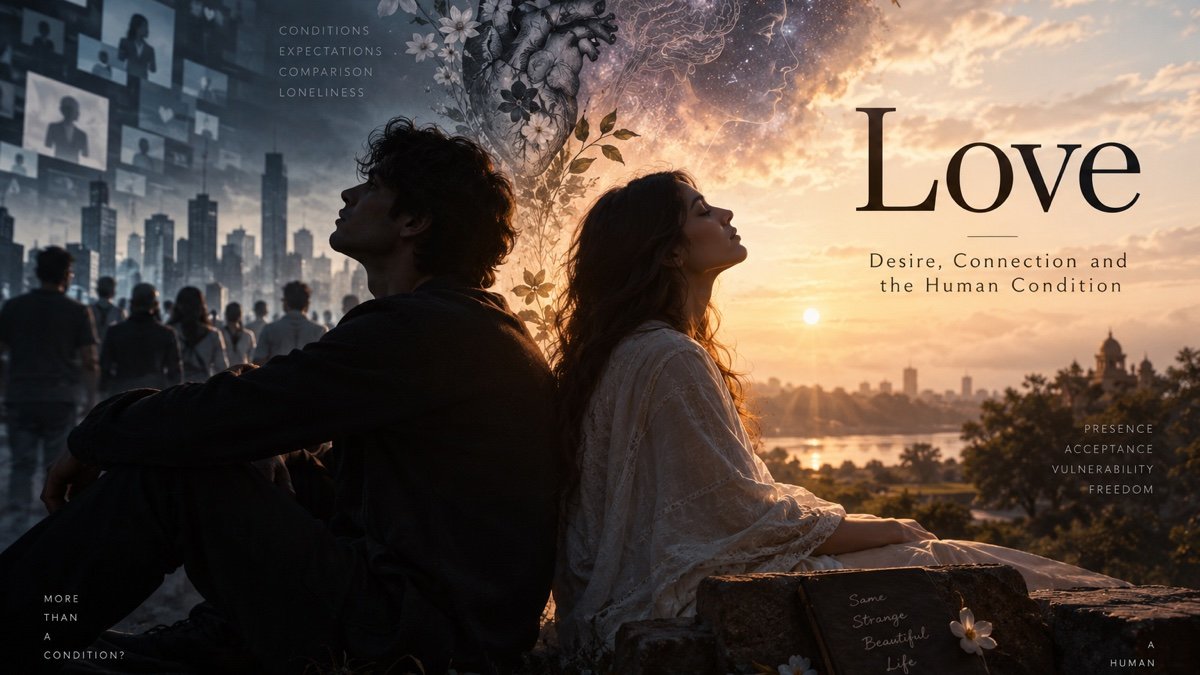
We arrive in this world without being consulted about any of its initial conditions. Geography is assigned before identity, family before preference, economic circumstance before ambition, and biological inheritance before self-understanding. If those coordinates happen to be favourable, existence may acquire a certain softness very early. If they are not, the same world can become brutally extractive. For a great number of people, life is not primarily experienced as discovery, self-expression, romance or philosophical curiosity; it is experienced as labour, financial anxiety, obligation, physical exhaustion and the continuous attempt to remain functional inside circumstances they never consciously chose.
Perhaps that is one reason love fascinates me so much. Almost everything else around us appears, at least partially, to belong to some transactional architecture. Economics is organised around exchange. Politics is organised around coordination and power. Technology expands capability. Institutions regulate behaviour. War emerges when competing interests become irreconcilable enough to cross into violence. Even many human relationships contain invisible negotiations involving security, status, attraction, reciprocity, usefulness and belonging. Yet somewhere inside all of this machinery there exists a phenomenon we call love, and although it is probably entangled with biology, psychology and circumstance, it still seems to resist being reduced completely to any of them.
I sometimes think of love as a frequency. I do not mean that literally, and certainly not in the pseudoscientific sense of assigning affection a mystical numerical vibration. I mean frequency as a metaphor for a mode of human resonance. Everything about being alive involves movement. The heart contracts, speech displaces air, touch becomes electrical and chemical activity inside the nervous system, and thought alters physiology whether we notice it or not. Human beings are continuously affecting one another through signals that are verbal, biological, emotional and behavioural. Somewhere inside that vast exchange, another consciousness can begin to matter to us with an intensity that appears almost disproportionate to ordinary rational calculation.
That alone is strange. What makes it stranger is that love refuses to behave like most other desirable outcomes.
If I want to become physically stronger, I can train. If I want to understand a subject, I can study it. If I want to become better at music, writing, programming or sport, I can direct repeated effort towards the skill and expect some relationship between input and output. If I want financial stability, there are actions that may increase the probability of achieving it. None of these outcomes is guaranteed, but the mechanism is at least intelligible: effort enters a process, and probability changes.
Love does not submit to that architecture very easily. There is no amount of effort through which another consciousness can be compelled to freely love you. You can become more attractive, emotionally mature, socially capable, financially stable, generous or interesting, and all of those things may alter probability, but the final phenomenon remains outside direct control. You cannot earn another person's love in the same way you earn competence. You cannot purchase its genuine form without converting it into something else. You cannot demand it without injuring the freedom that gives it meaning. It emerges, or it does not.
There is something almost offensive about that to the part of the human mind that wants causality to remain negotiable. Perhaps that is why love can feel like magic. Not because it necessarily exists outside biology or psychology, but because it is one of those rare human experiences in which enormous subjective significance appears without being completely producible through deliberate effort. In that sense, love resembles existence itself. None of us requested admission to this strange event called life; we simply appeared inside it. And occasionally, among billions of other people who arrived under equally absurd conditions, one consciousness encounters another and begins assigning extraordinary importance to its existence.
I find that beautiful. I also find it suspicious.
What Exactly Are We Calling Love?
The romantic answer is easy. Love is pure, love sees beyond appearances, love survives everything. I am not sure human beings are that simple. Attraction has biology inside it. Attachment has neurochemistry inside it. Appearance matters. Timing matters. Personality matters. Security matters. Familiarity matters. Social conditioning matters. Our previous wounds probably determine far more of what feels safe, desirable or emotionally significant than we are usually comfortable admitting.
We use one word, love, to describe a phenomenon that may contain desire, affection, loneliness, admiration, attachment, sexual attraction, projection, dependency, compatibility, memory and unconscious pattern recognition. The existence of those ingredients does not automatically make love fraudulent. It simply means that purity may be considerably more complicated than the stories we have built around it.
This is where the question becomes uncomfortable for me. Would somebody love me without status? Without money? Without physical attractiveness? Without confidence? Would that love survive professional collapse, illness or psychological deterioration? Would the same person remain if the qualities that originally made me desirable were temporarily absent? And equally importantly, would I remain for them under the same conditions?
It is extremely easy to demand unconditionality from another person while remaining profoundly conditional ourselves. We want to believe someone would recognise our essence beneath every external deterioration, but how often are we willing to perform the same act of recognition in return?
Maybe that is one of the reasons I find the subject difficult. I have seen what conditionality looks like from the side where the conditions are no longer favourable.
When Desirability Disappears
There was a period in my life when my psychological condition affected nearly every visible part of me. My body changed, my appearance deteriorated, self-care disappeared, my behaviour changed and ordinary social participation became increasingly difficult. I became less presentable, less coherent and probably much harder to be around.
The world behaved differently towards that version of me.
I do not say this as an accusation against humanity. People have limits. Psychological instability can exhaust relationships. Human beings are naturally drawn towards predictability, vitality, security and social ease, and they often withdraw from situations they do not know how to handle. I understand that now more than I did then.
But once you have experienced how radically social reality can change when your desirability declines, affection becomes difficult to interpret innocently. If people begin moving towards you again when you become healthier, more attractive, more successful, more articulate or more useful, an uncomfortable question inevitably appears: what exactly are they moving towards? The person, or the conditions surrounding the person?
Perhaps that question is itself imperfect. A human being can never be encountered without conditions. We are always embodied, situated and expressed through some combination of appearance, behaviour, history and circumstance. There may be no pure inner person floating independently from all of that.
So perhaps the absence of conditions is the wrong standard for love.
Maybe the more meaningful question is whether love can eventually become larger than the conditions through which it first arrived.
The Girl
There is a girl I like very much. Perhaps I love her. I deliberately remain uncertain about the word because I do not want emotional intensity alone to become sufficient evidence.
She appears in my dreams. I imagine taking care of her, writing music for her, making her feel safe, doing small things simply because her happiness would make me happy. There is a softness inside those thoughts that feels different from ordinary attraction.
Then another part of my mind begins analysing the entire experience. Why her? Why, among billions of human beings, did my mind assign unusual significance to this particular person? There must be an internal architecture producing that preference. Something about her appearance, personality, manner, whatever I actually know about her and perhaps whatever I have projected onto her fits some pre-existing pattern inside me.
In less romantic language, she fits my code.
That immediately complicates my desire to call the emotion pure. If those characteristics were radically different, would I feel the same way? Probably not. Which means that even an emotion I experience as transcendent may have entered consciousness through ordinary biological and psychological gateways.
I do not think that conclusion necessarily destroys love. Perhaps attraction is conditional while love can later become something more than the conditions that initiated it. Maybe appearance opens the door. Maybe compatibility keeps somebody in the room. And maybe love begins only when the other person ceases to be merely a collection of qualities that satisfy us.
I genuinely do not know. But that possibility interests me far more than the idea that love must somehow be biologically pure in order to be spiritually meaningful.
Love Inside the Dopamine Economy
There is another difficulty in trying to understand love today: the environment in which we are attempting to experience it. Modern technology has become extraordinarily sophisticated at industrialising desire. Swipe, compare, match, refresh, replace. Another face, another possibility, another notification, another microscopic promise that something slightly more satisfying might exist after one more movement of the thumb.
Technology did not invent human restlessness. People were jealous, unfaithful, insecure, opportunistic and status-conscious long before smartphones existed. The animal was already there. What technology changed was the environment available to that animal.
Love appears to require sustained attention, while a large part of the digital economy profits from fragmentation. Love eventually requires encountering the limitations of another human being, while consumer psychology repeatedly teaches us to interpret dissatisfaction as evidence that a better option may exist elsewhere. Love requires accepting that another consciousness can never be perfectly optimised around our needs, while digital systems increasingly acclimatise us to personalised environments that respond immediately to preference.
I wonder what happens when the psychology of intimacy is placed inside an architecture of apparently infinite optionality. When another possibility is always visible, commitment begins competing with imagination. There may always appear to be someone more attractive, more compatible, more successful, more emotionally effortless or more aligned with whichever version of ourselves exists at that moment.
Perhaps love has not become rarer. Perhaps the noise surrounding desire has simply become much louder.
What Would Pure Love Actually Mean?
Maybe pure love is not affection without conditions. Human beings may simply be incapable of that. We encounter one another through bodies, histories, personalities and circumstances. Every relationship begins somewhere specific: a face, a voice, a conversation, a shared experience, a particular stage of life. Conditions are not necessarily contamination; they may simply be the doorway through which another consciousness first becomes visible to us.
So perhaps purity requires another definition.
Maybe love begins becoming purer when the other person stops existing primarily as an instrument for our own emotional regulation. There is a profound difference between loving someone because of what their existence does to us and reaching a point where their existence acquires value that cannot be completely reduced to what we receive from them.
That does not mean tolerating abuse, abandoning boundaries or converting self-destruction into a romantic virtue. Love without self-respect can become pathology as easily as desire can become possession. But perhaps genuine love contains a certain decentralisation of the self. For a moment, another person's well-being matters independently of our own immediate reward.
Possession asks whether the person can remain ours. Love may eventually ask whether the person can remain themselves.
This may also explain why love can become frightening even when nothing has gone wrong. Another human consciousness can never completely belong to us. No amount of intimacy abolishes autonomy. The person can change, leave, stop loving us, become somebody we no longer recognise, or simply disappear through death. To love is therefore to assign extraordinary value to something one can never completely control.
For an organism obsessed with prediction, control and threat reduction, that is an unusually vulnerable position.
Perhaps that vulnerability is not an unfortunate side effect of love. Perhaps it is part of its structure.
Maybe I Am Writing This Because I Do Not Have It
There is another possibility I cannot remove from the analysis without becoming dishonest. Maybe I am philosophising love because I do not currently possess the kind of love I am describing.
Perhaps deprivation creates abstraction. If someone were sitting beside me whom I loved deeply and who loved me with equivalent certainty, perhaps I would not be interrogating the metaphysics of intimacy. Maybe I would simply be living it. Perhaps I am searching for purity partly because ordinary closeness has been absent from a substantial part of my life.
Maybe philosophy is occasionally what the mind constructs around an experience it wants but cannot reach.
That possibility does not invalidate the questions, but it changes the authority with which I should ask them. I am not writing as somebody who has solved love. I may be writing as somebody standing outside a house, trying to understand warmth by looking through a window.
And if one day I experience the relationship I currently imagine, perhaps I will return to this essay and discover that large portions of it were wrong.
I would be very happy to discover that.
When Everything Else Is Removed
Still, one question remains difficult for me to abandon. What happens to love when the socially desirable layers of a person begin disappearing?
Youth changes. Beauty changes. Money can disappear. Careers collapse. Bodies become ill. Confidence can break. Personality can be altered by grief, disease or psychological suffering. Eventually every sufficiently long relationship encounters some form of impermanence.
Perhaps that is where affection confronts its real examination. Not through artificially creating suffering to test another person, that would itself be a distortion of love, but through the ordinary instability that life eventually introduces without permission.
What remains when utility declines?
Would another consciousness continue to matter when it temporarily stops providing status, pleasure, convenience, attractiveness or emotional regulation? Perhaps that is one boundary between attachment and love. Not the complete absence of self-interest, because human beings may be too psychologically entangled for such purity, but the ability of care to survive periods in which immediate self-interest receives very little reward.
Economics measures exchange. Power measures control. Competition measures relative position. Technology measures capability. Love seems to resist clean measurement because its most interesting moments often appear where the transaction becomes inefficient.
You cannot force it. You cannot purchase its genuine form. You cannot completely secure it. You cannot even know with perfect certainty that another person experiences it in exactly the way you imagine. You can only offer some version of yourself and accept that another consciousness remains free to respond however it responds.
Perhaps that freedom is not an inconvenience attached to love.
Perhaps it is what makes love possible.
I do not know whether love is a metaphysical force, an emergent property of sophisticated mammalian cognition, a biological adaptation that sometimes grows beyond the function evolution originally gave it, something divine, or some combination of explanations our current categories are too crude to reconcile.
I only know that after economics, ambition, power, status, technology, competition and all the systems human beings have constructed around themselves, this apparently simple phenomenon continues to possess an unusual authority over us. People who possess almost everything still want it. People who lose almost everything still search for it. Human beings continue writing songs about it after thousands of years of other human beings having already written the same song.
Perhaps that persistence means something.
Maybe the closest I can currently come to defining love is this: it begins somewhere inside attraction, biology, circumstance and need, as almost every human relationship probably must, but perhaps it becomes something more profound when the central question slowly changes from What does this person provide to my life? to Why has this person's existence begun to matter to me beyond what I can extract from it?
I do not know whether that is pure love. Maybe purity itself is an impossible standard for creatures as conditional as us. But somewhere inside that transition, I think there is something worth protecting, and for now, that is enough for me. Hare Krishna.