The Cognitive Frontier
The world around the mind changed faster than the mind could. On attention, threat, reward, incentives and why cognitive awareness is the next frontier.
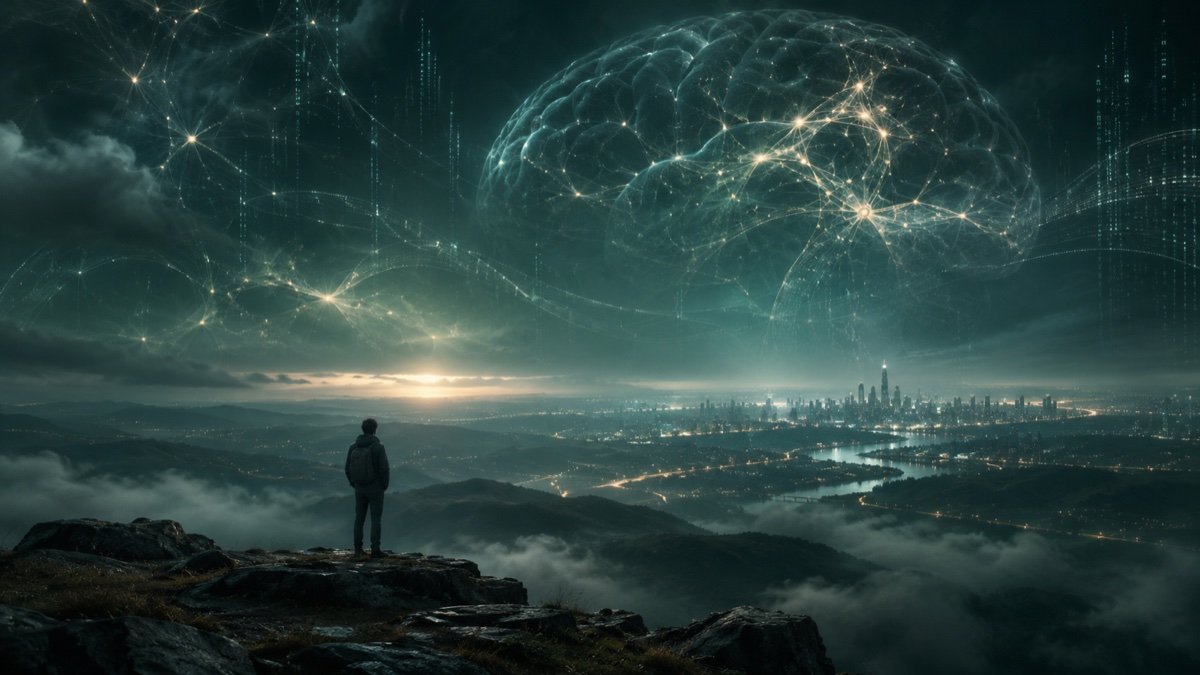
There is something about the way we live today that I find increasingly difficult to ignore. I do not mean that human beings were somehow “meant” to live in forests, or that technology has taken us away from some perfect natural existence. I do not believe there ever was such a perfect existence. What I mean is much simpler: the environment around the human mind has changed at a speed at which the mind itself could not possibly have biologically changed with it.
Most of what we now consider ordinary is historically very recent. Industrialisation itself is only a few centuries old, but the acceleration of the last hundred years, and particularly the last twenty or thirty, is something else altogether. Mass media, computers, the internet, smartphones, social networks, instant communication and now artificial intelligence have repeatedly changed the environment in which our attention operates. A person living today can wake up in a room in India and, before leaving bed, expose his nervous system to a war thousands of kilometres away, somebody else's financial success, a political crisis, pornography, a stock-market crash, a friend's marriage, an advertisement, a joke and an argument between complete strangers. All of this can happen within ten minutes.
I don't think we fully understand what that means yet.
Our technological environment has evolved extraordinarily quickly. The cognitive machinery entering that environment is still, in many important ways, old. This does not mean our brains are primitive or incapable of adapting. Adaptability is perhaps one of the reasons our species has survived at all. But adaptation is not the same thing as immunity. An organism can learn to function inside an environment without that environment necessarily being ideal for it.
This is why I increasingly feel that one of humanity's next serious achievements may have very little to do with building another machine. We will obviously continue doing that, and we should. But alongside technological advancement, we may need something I would loosely call cognitive awareness: a much more ordinary understanding of what our own minds are doing while we are using all this technology.
Not enlightenment. Not some mystical state in which everybody becomes peaceful. Just awareness.
And perhaps even that would be a very large achievement.
We Have Become Used to an Extraordinary Amount of Reality
There are things we now encounter so regularly that their psychological abnormality has almost disappeared.
War is one example.
A war begins somewhere, thousands of people die, families disappear, cities are destroyed, and the information reaches us through the same rectangle through which we order dinner. We feel something, perhaps anger or sadness, and then another piece of information replaces it. I am not saying this because I think people are heartless. In fact, the opposite explanation may be more reasonable: a human nervous system simply cannot emotionally process the suffering of an entire planet at full intensity every day and continue functioning.
So we adapt.
Psychology already gives us concepts such as habituation and attentional adaptation, but I am not trying to make a precise neuroscientific claim here that repeated news exposure has somehow “normalised war” inside the brain. I am making a much simpler observation. Extraordinary things can become psychologically familiar when we encounter representations of them frequently enough.
That itself creates a strange situation. Something can remain morally horrifying while becoming cognitively ordinary.
I don't know exactly what that does to a civilisation over several generations. I doubt anybody knows with certainty. But I think it deserves more curiosity than we currently give it.
The same applies to violence, outrage, political conflict, social comparison and even personal tragedy. Humanity has always lived with these things. What changed is our exposure radius. The village became the planet, but the nervous system did not suddenly acquire infinite emotional bandwidth.
Maybe the Problem Is Not Evil People
When I originally thought about this, my instinct was to blame the people controlling these systems. Corporations want profit. Platforms want attention. Films will show almost anything if it sells. Political systems will use fear if fear produces votes. It becomes very tempting to look at the people sitting at the top and conclude that they simply do not care what happens to everybody underneath them.
Sometimes that criticism may be justified.
But I think the deeper explanation is probably less dramatic and therefore more dangerous.
The system does not necessarily require evil people.
A social platform wants engagement because without engagement the company does not survive. An advertiser wants attention because without attention the advertisement fails. A film producer wants an audience because the economics of filmmaking require one. A politician wants votes because without votes the politician has no political power. From within each small system, the optimisation makes complete sense.
The problem appears when all of these systems discover the same human vulnerabilities.
Fear gets attention. Anger gets attention. Novelty gets attention. Sexual attraction gets attention. Status gets attention. Tribal conflict gets attention. None of these mechanisms was invented in Silicon Valley. They were already inside us.
Technology simply became extremely competent at finding them.
That distinction matters to me because it changes the problem. If society were being damaged only by a few terrible people, perhaps replacing those people would solve it. But if the damage occasionally emerges from perfectly rational actors responding to incentives that reward the exploitation of predictable psychological tendencies, then the issue is structural.
This is why I have become more interested in incentives than villains.
I do not think every technology company secretly wants people anxious or addicted. That sounds intellectually lazy to me. But I also do not think the commercial objective of maximising engagement automatically aligns with the psychological objective of producing calm, self-aware human beings. Sometimes those objectives overlap. Sometimes they clearly do not.
And this is where individual awareness becomes important.
We Learn Everything Except the Instrument Through Which We Learn
This part genuinely confuses me.
We consider it completely reasonable to teach children mathematics, economics, biology, history, accounting and, eventually, subjects such as finance or marketing. We understand that these systems have rules, and that understanding those rules makes a person more capable of navigating reality.
But the mechanism through which the person experiences all of those systems—the mind itself—receives surprisingly little ordinary education.
Most people eventually learn that attention can be manipulated, but usually after their attention has already been manipulated for years. We discover cognitive biases somewhere in adulthood, if at all. We experience anxiety without necessarily understanding what uncertainty does to threat perception. We build habits without understanding very much about reinforcement. We make decisions while emotions are shaping those decisions, and then consciousness often produces very sophisticated explanations for why the conclusion was completely rational.
I include myself in all of this.
I am not describing some intellectually inferior population being controlled by clever people. I notice these mechanisms in myself all the time. Sometimes the awareness arrives embarrassingly late.
This is why metacognition interests me so much. Metacognition is a legitimate area of psychological research; broadly speaking, it concerns our ability to observe and evaluate our own cognitive processes. I do not think research currently justifies the claim that teaching metacognition will somehow eliminate manipulation, conflict or human irrationality. That would be pseudoscience dressed as optimism.
But the modest claim is already powerful enough: human beings can develop at least some ability to become more aware of how they are thinking.
Why is that not more fundamental to education?
A child does not need to become a neuroscientist. The same way a person can understand compound interest without becoming an economist, perhaps they can understand basic attention, emotional regulation, cognitive bias, habit formation, social conformity and threat perception without acquiring a psychology degree.
Not so that somebody tells them what to think.
Almost the opposite.
So that they become slightly better at recognising what may already be influencing how they think.
The Mind Was Not Built to Be Perfectly Neutral
There is another idea I have had to correct in my own writing. I used to say things like, “The brain was designed for survival, not truth.” It sounds powerful, but scientifically it is too clean.
Evolution does not “design” the mind in the way an engineer designs a machine, and accurate perception is obviously useful for survival. An organism completely detached from reality does not last particularly long.
The more precise point is that our cognitive architecture evolved under pressures of survival and adaptation; it was never required to provide some perfectly neutral philosophical representation of reality.
That helps explain why threat occupies such a privileged position.
If an animal mistakes a harmless sound for a predator, it wastes some energy. If it repeatedly mistakes an actual predator for a harmless sound, its evolutionary career may end rather abruptly. Sensitivity to possible danger therefore makes sense.
The problem is not that this mechanism exists. We need it.
The problem is that the category of “threat” has become enormous.
A falling stock price can become threat. A message from somebody we love can become threat. A political headline can become threat. A stranger insulting us from another continent can become threat. Someone else's success can become a threat to our sense of status. A notification containing no physical danger whatsoever can change the state of the body.
We increasingly respond not only to reality but to representations of reality, and we now receive those representations continuously.
I find that historically fascinating.
Reward Is Equally Complicated
The same caution applies to dopamine. I have used phrases such as “dopamine economy” before because they communicate an intuitive idea quickly, but they are scientifically crude. Dopamine is not simply a pleasure chemical. It participates in a much more complicated network involving motivation, reinforcement, learning, incentive salience and prediction.
So I am less interested now in saying, “Technology gives us dopamine hits,” and more interested in the structure of the environment itself.
The interval between desire and gratification has become incredibly small.
Hungry? Food can arrive.
Bored? Thousands of videos are waiting.
Lonely? Open an app.
Horny? Infinite stimulation exists.
Curious? An answer appears in seconds.
Want something? Buy it without leaving the bed.
None of these things is inherently bad. I enjoy convenience as much as anybody else. I am not interested in manufacturing morality around suffering as though everything difficult is virtuous and everything pleasurable is corrupt.
I am interested in what repeated immediacy does to expectation.
If enough of life becomes instant, what happens to our tolerance for processes that are necessarily slow? Reading. Learning. Building a relationship. Becoming genuinely good at something. Sitting with boredom long enough for a thought to develop.
I do not think the science allows me to claim one universal answer. Research around digital media, attention and well-being is far more complicated than the internet usually presents it. Different technologies affect different people differently.
But again, not having a final answer does not make the question worthless.
This Is Where I Start Speculating
Up to this point, much of what I am talking about has at least some relationship with established areas of psychology and cognitive science. From here, I am making an inference.
I wonder what happens if cognitive awareness becomes ordinary.
Not perfect self-control. Not eight billion enlightened people. Just a population in which more individuals understand that their first emotional interpretation is not necessarily objective reality.
Someone experiences fear and recognises that fear may be magnifying probability. Someone becomes furious at a political story and waits long enough to investigate whether the story was framed to produce precisely that reaction. Someone notices envy without immediately constructing a moral argument against the person being envied. Someone recognises that an advertisement is manufacturing inadequacy before attempting to sell the cure.
Would that create a better civilisation?
I don't know.
Science certainly has not demonstrated that causal chain at the scale of society.
But intuitively, I find it difficult to believe that increasing people's ability to observe their own cognitive processes would be entirely irrelevant to collective behaviour.
Society is not a separate organism floating above human beings. It emerges from enormous numbers of individual interactions, and then acts back upon those individuals. Individual psychology produces institutions; institutions influence individual psychology. The direction of causality continuously loops.
Perhaps a small increase in awareness at the individual level would change almost nothing.
Perhaps it would change more than we expect.
That is the experiment I find interesting.
We Are Animals, and That Is Not an Insult
The largest objection to this entire idea is also the one I take most seriously.
We are animals.
Fear, sexual desire, status, competition, aggression, group loyalty and reward seeking are not little defects inserted into an otherwise perfectly rational mind. They are deeply entangled with what we are.
There is a version of spiritual and technological optimism that imagines humanity somehow graduating beyond its biology. I don't find that very convincing.
Nor do I necessarily want it.
Fear protects us. Desire moves us. Competition sometimes produces excellence. Loyalty allows people to sacrifice for something beyond themselves. Anger can reveal that a boundary has been violated. Aggression, however uncomfortable the word may be, can become necessary when something genuinely requires defence.
The objective cannot be to kill the animal.
Perhaps it is simply to recognise the animal while it is operating.
That sounds smaller, but I think it is considerably more profound.
I may still become afraid, but perhaps I can occasionally notice when fear has become the author of my interpretation. I may still desire something intensely, but perhaps I can distinguish desire from necessity. I may love my group, country or community deeply while noticing the exact moment that loyalty asks me to stop recognising the humanity of somebody outside it.
Nothing has been eliminated.
There is simply another layer watching.
Maybe that is what awareness really is.
The Frontier
Humanity has spent an extraordinary amount of time learning how to control the external world. We learned agriculture, engineering, medicine, electricity, computation, genetics and now increasingly sophisticated artificial intelligence. I am grateful for almost all of it. I have no romantic desire to return to a world where an infection could casually kill me because modern medicine had not yet been invented.
But perhaps we have reached a strange point where increasing external capability without increasing internal awareness begins producing diminishing returns.
A more powerful tool in the hands of a frightened mind is still being directed by fear. A more powerful communication network inside a tribal psychology can distribute tribalism faster. A more intelligent algorithm interacting with poorly understood human vulnerabilities can become extremely effective at amplifying those vulnerabilities.
So perhaps the next frontier is not the mind instead of technology.
It is understanding the mind because technology has become so powerful.
I don't know what that looks like institutionally. Maybe basic cognitive literacy becomes part of education. Maybe psychology becomes less separated from ordinary life. Maybe neuroscience gives us better models. Maybe artificial intelligence eventually becomes useful as a mirror through which people recognise recurring patterns in themselves. Perhaps contemplative traditions also contain techniques worth examining seriously without forcing somebody to accept every metaphysical claim attached to them.
I genuinely don't know.
What I do know is that I find it increasingly strange that a civilisation capable of constructing artificial intelligence can still leave a person largely alone to discover the architecture of their own mind through accident, suffering or therapy after something has already gone wrong.
Perhaps cognitive awareness will never become the great collective leap I imagine. Perhaps our instincts are stronger, our institutions more complicated and our behaviour less tractable than my hypothesis assumes. That possibility is real, and I would rather preserve it than turn an interesting idea into another ideology.
But even if the ambition remains much smaller, I think it is worth pursuing. If understanding one's own cognition gives a person even a slightly larger interval between stimulus and reaction, that interval has value. Somewhere inside it, fear can be examined before becoming certainty, anger before becoming action, desire before becoming compulsion and persuasion before becoming belief.
I am not claiming that one additional moment of awareness will fix humanity.
I am saying I would like to know what becomes possible if more of us have that moment more often.
For all the intelligence we have invested into understanding the world outside us, perhaps it is finally time to take the instrument doing the understanding just as seriously.