The System's Blind Spot
Why systems built to reward performance remain primitive at recovery and what a more advanced civilisation might measure instead.
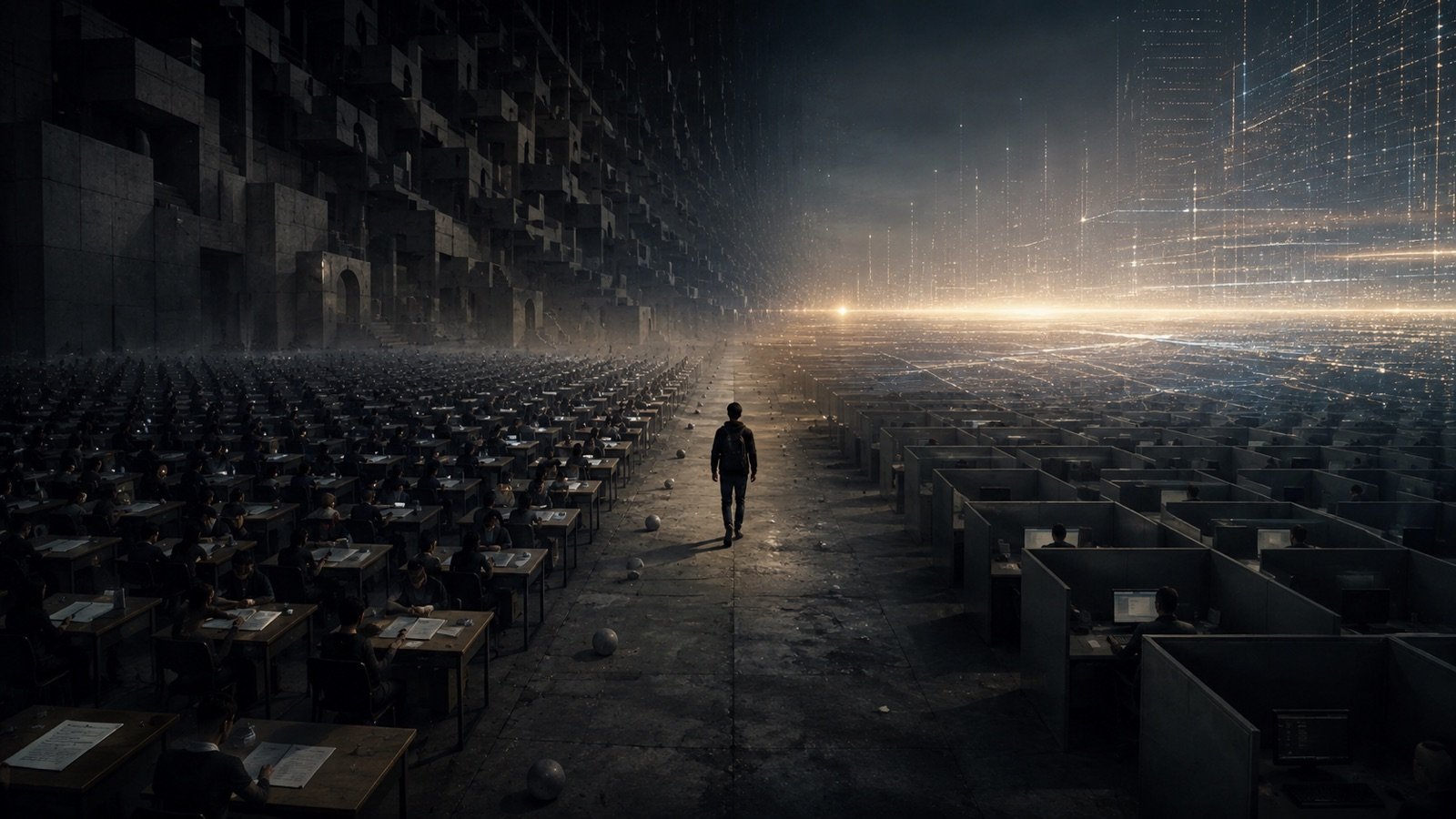
Most modern systems are designed around the assumption of continued participation. A person studies, enters the economy, acquires responsibilities, produces value, competes, adapts, and keeps moving through the structure. The system has refined mechanisms for telling levels of performance apart. What it has far fewer mechanisms for is something else entirely.
What happens when a human being becomes temporarily incapable of participating at all?
This is where the architecture becomes strangely primitive. Modern civilisation has become extraordinarily good at optimising individuals who are functioning, and remains comparatively crude at reintegrating individuals whose functioning has collapsed.
That distinction matters, because competition, however productive it may be, carries an unmistakably biological logic. Nature selects. Organisms compete for scarce resources. Those better adapted to a particular environment gain an advantage, and those unable to adapt are progressively displaced. Human civilisation has never completely escaped this logic. Markets contain it. Careers contain it. Educational systems contain it. Social hierarchies contain it. Perhaps they always will.
Competition is not inherently pathological. It can generate excellence, innovation, discipline, and extraordinary increases in collective capability. But civilisation cannot merely be natural selection with better infrastructure.
One of the central achievements of civilisation has been our ability to interfere with the indifference of nature. Nature does not provide hospitals. We do. Nature does not guarantee legal protection to the physically weaker. We attempt to. Nature does not create social insurance, public education, rehabilitation, or institutional mechanisms for second chances. Human beings do.
In that sense, civilisation is partly the construction of an artificial layer between biological reality and human destiny. We decided, imperfectly, that survival should not depend entirely upon strength. That justice should not depend entirely upon power. That opportunity should not depend entirely upon birth.
Perhaps the next evolution of that principle concerns the mind.
Our institutions still operate, to a remarkable extent, as though cognitive functionality were a stable property of the individual. It is not. A human being is not an economic unit carrying a fixed quantity of intelligence and motivation into the marketplace every morning. Cognition itself is environmentally contingent.
Chronic stress alters cognition. Isolation alters cognition. Humiliation alters cognition. Economic insecurity alters cognition. Loss of agency alters cognition. Prolonged uncertainty alters cognition. Meaning, or its disappearance, alters cognition.
The individual mind and the collective environment are therefore not independent systems. They are coupled systems. Society acts upon cognition, cognition acts upon behaviour, behaviour aggregates into institutions, and institutions reshape the society that acts upon the next generation of minds. The loop is continuous.
Yet we continue designing many institutions as though psychological conditions were private variables sitting outside the architecture. They are not outside it. They are partly produced by it.
This becomes especially difficult to ignore at the extreme boundary of psychological collapse. When a human mind reaches a condition in which continued existence begins to be evaluated as less tolerable than its termination, something extraordinary has occurred. An organism whose most primitive biological machinery is organised around survival has reached a cognitive state capable of overriding that machinery.
Whatever else we call this, clinical, psychological, neurological, social, it should also interest us as a civilisational signal. A civilisation capable of coordinating global financial markets in milliseconds, placing machines on other planets, and constructing artificial intelligence should also be curious about the conditions under which one of its own members becomes so overwhelmed that existence itself is perceived as the problem.
This does not mean society is responsible for every internal state of every individual. That would be both intellectually dishonest and practically impossible. Human suffering has biological, personal, interpersonal, and environmental causes too complex to reduce to a single institution. But the opposite conclusion is equally inadequate: that psychological collapse belongs entirely to the individual, and therefore sits outside systems thinking. It does not.
I came to understand the importance of this distinction only after encountering, personally, what it means to fall far enough outside the normal sequence of functioning. What stayed with me afterwards was not simply the experience. It was the architectural question it exposed.
Our systems contain elaborate pathways for advancement and surprisingly few pathways for return. We understand progression far better than reintegration. We know how to reward the person accelerating through the system. We are far less capable when it comes to the person whose cognitive machinery has temporarily stopped cooperating with the demands of that system.
Perhaps this is where the idea of progress itself needs to mature. The objective cannot be the elimination of competition. Nor should a society remove personal responsibility, ambition, consequence, or standards in the name of compassion. A system without pressure can stagnate just as easily as a system with excessive pressure can break people.
The problem is not competition. The problem is monoculture: an entire social architecture built around a single psychological mode. Compete. Perform. Optimise. Advance.
A more advanced system would keep those mechanisms while developing another architecture alongside them. Recovery, reintegration, cognitive restoration. It would understand that human capability is dynamic. That a person functioning at twenty percent today is not necessarily a twenty-percent human being. That temporary economic uselessness and intrinsic human worth are conceptually different things. That restoring agency may sometimes matter more than demanding productivity. And that the long-term efficiency of a civilisation may actually depend on its ability to recover human potential that would otherwise be discarded.
This is where individual psychology and collective psychology become impossible to separate. The next generation of systems may need to think not only in terms of GDP, employment, output, and efficiency, but also in terms of cognitive bandwidth, agency, psychological resilience, social belonging, and recoverability. Not as sentimental additions to economics. As variables inside the system itself.
Because the most sophisticated civilisation will not necessarily be the one that extracts maximum performance from those already capable of running fastest. It may be the one capable of producing extraordinary performance without treating temporary human collapse as permanent human redundancy.
Perhaps that is the transition beyond the purely animalistic architecture of competition. Not the destruction of the race. The construction of a civilisation in which losing your place in the race does not mean losing your place in the world.